The History of the Ice Cream Cone: From Waffles to World’s Fairs
There is a specific kind of culinary magic reserved for the edible container. In the world of desserts, nothing exemplifies this harmony of form and function quite like the ice cream cone. It is the ultimate zero-waste packaging—a crunchy, buttery vessel that protects its frozen cargo until the very last bite. At PizzaCream, we believe that understanding the vessel is just as important as understanding the cream itself. But before the cone became a staple of every boardwalk and artisanal scoop shop, it was a revolutionary solution to a very messy problem.
The Early Days: Waffles and “Hokey-Pokey” Men
Long before the standardized cone, ice cream was a luxury enjoyed primarily from glass “penny licks.” Customers would pay a penny to lick a small dab of ice cream out of a heavy glass cup, which was then handed back to the vendor, supposedly wiped clean, and refilled for the next person. As you might imagine, this was a public health nightmare. By the late 19th century, the “hokey-pokey” men—street vendors who sold inexpensive ice cream—began looking for more sanitary alternatives.
Early iterations of the edible container appeared in the form of “ice cream sandwiches” made with thin wafers or paper-wrapped slices. In 1903, an Italian immigrant named Italo Marchiony filed a patent for a machine that molded edible cups with handles, but his design was more of a teacup shape than the pointed cone we recognize today. The true breakthrough required a bit of serendipity and the grand stage of a global event.
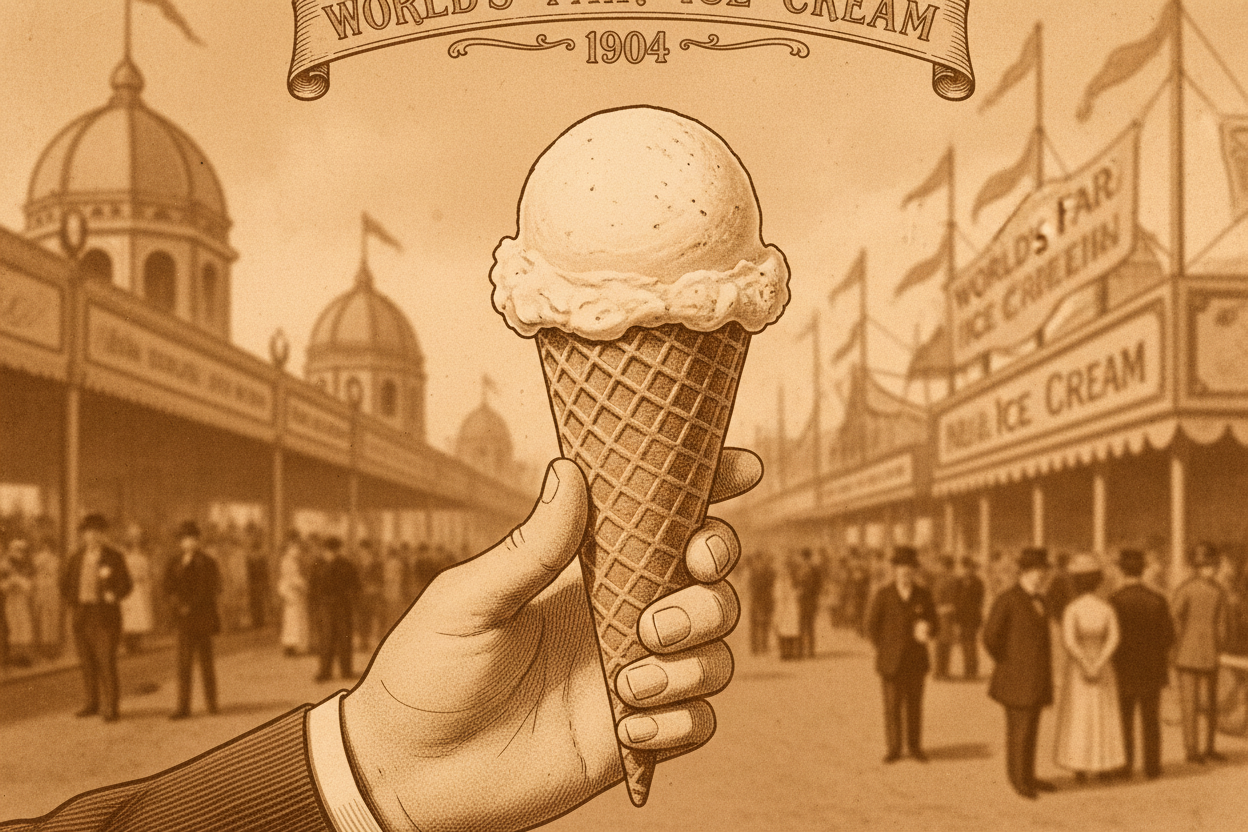
The 1904 St. Louis World’s Fair: A Legendary “Accident”
The 1904 Louisiana Purchase Exposition, better known as the St. Louis World’s Fair, is the birthplace of the modern ice cream cone legend. As the story goes, an ice cream vendor named Arnold Fornachou was doing such brisk business in the sweltering heat that he ran out of clean glass bowls. Next to his booth was Ernest Hamwi, a Syrian concessionaire selling zalabia—a crisp, waffle-like pastry sprinkled with sugar.
Seeing his neighbor’s predicament, Hamwi rolled one of his warm zalabia into a tapered cone and handed it to Fornachou. The pastry cooled and hardened within seconds, creating a sturdy, portable holder for the ice cream. The “World’s Fair Cornucopia” was an instant sensation. While several other vendors at the fair claimed to have invented the concept simultaneously, the Hamwi-Fornachou collaboration remains the most enduring tale of culinary improvisation in history.
Evolution of the Cone: From Hand-Rolled to Mass Production
Following the success in St. Louis, the demand for cones skyrocketed. Initially, every cone was hand-rolled, a labor-intensive process that limited production. However, the industrial revolution soon caught up with the dessert world. By the 1920s, automated machinery allowed for the mass production of “wafer cones” (the light, airy ones) and “sugar cones” (the sturdier, crunchier variety).
During this era, manufacturers began to realize that the cone’s geometry was essential for maintaining the integrity of the dessert. This period saw a deeper focus on the science of the perfect scoop, as the cone had to be strong enough to support the weight of the ice cream without becoming soggy too quickly. The introduction of the “waffle cone”—thicker and richer than the standard sugar cone—brought the industry back to its artisanal roots, offering a premium experience that complemented high-fat, gourmet ice creams.

Modern Artisanal Cones: How We See Cones Today
Today, we are witnessing a renaissance of the edible vessel. As the rise of artisanal ice cream continues to transform the industry, the cone is no longer an afterthought. Modern scoop shops are experimenting with flavored batters—incorporating activated charcoal, lavender, or even spicy chili—to create a multi-sensory experience.
At PizzaCream, we see the cone as the final frontier of flavor. Looking ahead at ice cream flavor trends for 2026, we expect to see even more integration between the pastry and the cream, with gluten-free and vegan cone options that don’t sacrifice that iconic crunch. From a Syrian pastry at a 1904 fair to the high-tech, small-batch creations of today, the ice cream cone remains a testament to the power of a simple, brilliant idea.